
Introduction
Modern agriculture is rapidly evolving as growers seek sustainable growing media that improve plant performance while reducing environmental impact. Among the many options available, cocopeat and vermicompost have become one of the most effective combinations for commercial farming, greenhouse production, home gardening, and organic agriculture.
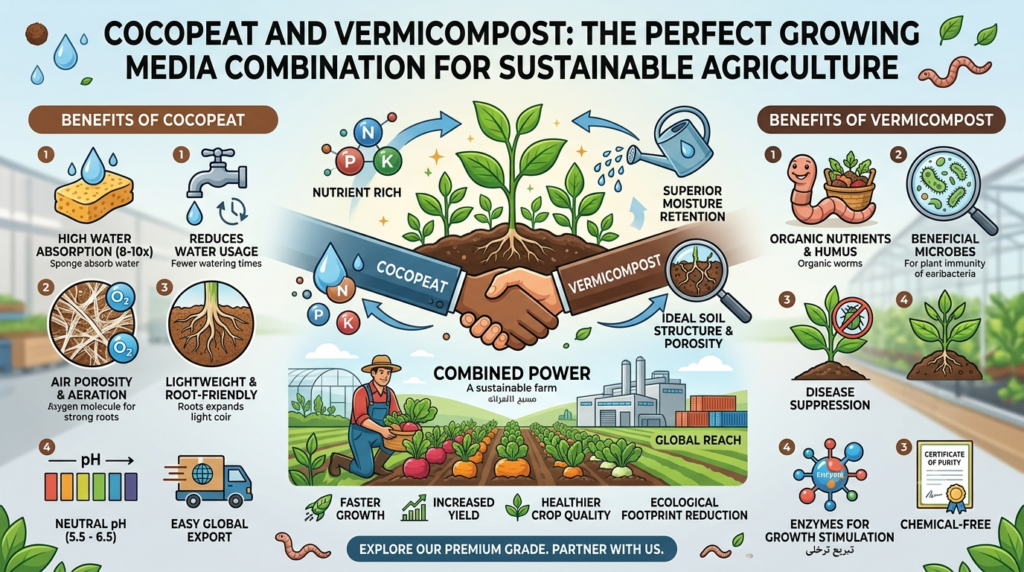
Cocopeat provides excellent water retention and root aeration, while vermicompost supplies a rich source of natural nutrients and beneficial microorganisms. Together, they create a balanced growing medium that supports stronger root systems, healthier plants, and higher crop productivity.
For international importers, agricultural distributors, and commercial growers, understanding how cocopeat and vermicompost work together can help identify high-quality products that meet the growing demand for sustainable horticultural solutions.
What Is Cocopeat?
Cocopeat is a natural growing medium produced from the fine pith found inside coconut husks. During the extraction of coconut fiber, this soft material is collected, cleaned, screened, and compressed into blocks or briquettes for easy transportation.
Unlike ordinary soil, cocopeat has a porous structure that holds water while maintaining enough air space for healthy root development.
Because it is renewable, biodegradable, and lightweight, cocopeat has become a preferred alternative to peat moss in many countries.
What Is Vermicompost?
Vermicompost is an organic fertilizer created through the natural digestion process of earthworms. Organic waste such as vegetable scraps, leaves, and agricultural residues is converted into nutrient-rich compost containing beneficial microbes and plant nutrients.
Compared with traditional compost, vermicompost usually has a finer texture and higher biological activity.
Growers value vermicompost because it naturally improves soil fertility without relying heavily on synthetic fertilizers.
Why Combine Cocopeat and Vermicompost?
Although each material performs well independently, combining them creates a more complete growing medium.
Cocopeat mainly improves the physical structure by increasing water retention and aeration.
Vermicompost improves the biological and nutritional properties by supplying essential nutrients and beneficial microorganisms.
This combination creates an ideal environment for root development and continuous plant growth.
Benefits of Cocopeat and Vermicompost
Excellent Moisture Retention
Cocopeat absorbs several times its weight in water, helping plants stay hydrated between irrigation cycles.
Vermicompost complements this by improving the soil’s ability to retain moisture naturally.
Improved Root Growth
Healthy roots require oxygen as much as water.
The porous structure of cocopeat prevents compaction, while vermicompost stimulates root development through natural plant growth compounds.
The result is stronger root systems capable of absorbing nutrients more efficiently.
Natural Nutrient Supply
Unlike cocopeat, which contains very few nutrients, vermicompost provides important elements such as:
Nitrogen
Phosphorus
Potassium
Calcium
Magnesium
Trace minerals
These nutrients become gradually available, reducing nutrient loss through leaching.
Better Soil Biology
Vermicompost introduces beneficial microorganisms that help improve nutrient cycling and suppress certain soil-borne diseases.
Combined with the stable physical properties of cocopeat, this creates a healthy environment for plant roots.
Environmentally Friendly
Both cocopeat and vermicompost originate from renewable organic materials.
Using them together supports sustainable farming while reducing dependence on non-renewable growing media and excessive chemical fertilizers.
Recommended Mixing Ratios
The ideal ratio depends on crop type and production system.
Common mixtures include:
Seed Starting
80% cocopeat
20% vermicompost
This provides sufficient moisture while avoiding excessive nutrients that may damage delicate seedlings.
Vegetable Production
70% cocopeat
30% vermicompost
Suitable for tomatoes, cucumbers, peppers, lettuce, spinach, and herbs.
Flower Production
60% cocopeat
40% vermicompost
Provides additional nutrients for continuous flowering.
Container Gardening
70% cocopeat
20% vermicompost
10% perlite
This mixture balances drainage, aeration, and nutrient availability.
Best Plants for Cocopeat and Vermicompost
This growing medium works well for numerous crops, including:
Vegetables
Tomato
Cucumber
Lettuce
Chili pepper
Eggplant
Fruits
Strawberry
Blueberry
Melon
Herbs
Basil
Mint
Parsley
Flowers
Rose
Orchid
Marigold
Indoor Plants
Monstera
Philodendron
Peace Lily
Snake Plant
Pothos
The versatility of this combination makes it suitable for commercial farms and home gardens alike.
How to Use Cocopeat and Vermicompost
The preparation process is simple.
First, rehydrate compressed cocopeat by adding clean water until it expands completely.
Next, mix the cocopeat with vermicompost according to the desired ratio.
Fill pots, nursery trays, or planting beds with the mixture.
Plant seeds or seedlings and water thoroughly after planting.
Monitor moisture levels regularly and supplement with balanced fertilizer if crops require additional nutrients during later growth stages.
Choosing Export-Quality Cocopeat
For international buyers, product consistency is a critical factor.
Reliable manufacturers typically produce cocopeat with:
Low EC
Balanced pH
High water holding capacity
Excellent expansion ratio
Uniform particle size
Minimal dust
Low moisture content
Clean appearance
Secure export packaging
These characteristics help ensure predictable growing performance across different climates and cultivation systems.
Why International Buyers Prefer Cocopeat
Global demand for cocopeat continues to rise because it combines sustainability with excellent horticultural performance.
Compared with traditional peat moss, cocopeat offers a renewable raw material, lower environmental impact, and efficient compressed packaging that reduces shipping costs.
When paired with vermicompost, it creates a premium growing medium that meets the needs of commercial agriculture, greenhouse production, landscaping, and organic farming.
For importers and distributors, this combination represents an attractive product category with increasing demand in Europe, North America, Australia, the Middle East, and Asia.
Conclusion
The combination of cocopeat and vermicompost offers an effective solution for growers seeking healthier plants, improved water management, and sustainable cultivation practices.
Cocopeat provides excellent moisture retention and root aeration, while vermicompost contributes valuable nutrients and beneficial microorganisms. Together, they create a balanced growing medium suitable for vegetables, fruits, flowers, herbs, and ornamental plants.
For international buyers, choosing premium export-quality cocopeat from an experienced manufacturer ensures consistent quality, reliable supply, and better long-term performance. As sustainable agriculture continues to expand worldwide, cocopeat and vermicompost remain one of the most practical and environmentally responsible growing media combinations available.