
Introduction
For professional growers, greenhouse operators, and agricultural importers, understanding the electrical conductivity of cocopeat is an essential factor when selecting high-quality growing media. EC value is one of the most important indicators used to measure the level of soluble salts present in cocopeat, which directly affects plant health, nutrient absorption, and crop productivity.
As global demand for sustainable horticultural substrates continues to increase, buyers are becoming more selective when sourcing export-quality cocopeat. Low EC cocopeat is highly preferred by commercial farms because it provides better control over fertilizer management and creates a safer environment for sensitive plants.
For international buyers looking for reliable cocopeat suppliers, understanding EC measurement helps ensure they receive products suitable for hydroponics, greenhouse cultivation, nurseries, and modern agricultural systems.
What Is Electrical Conductivity (EC) in Cocopeat?
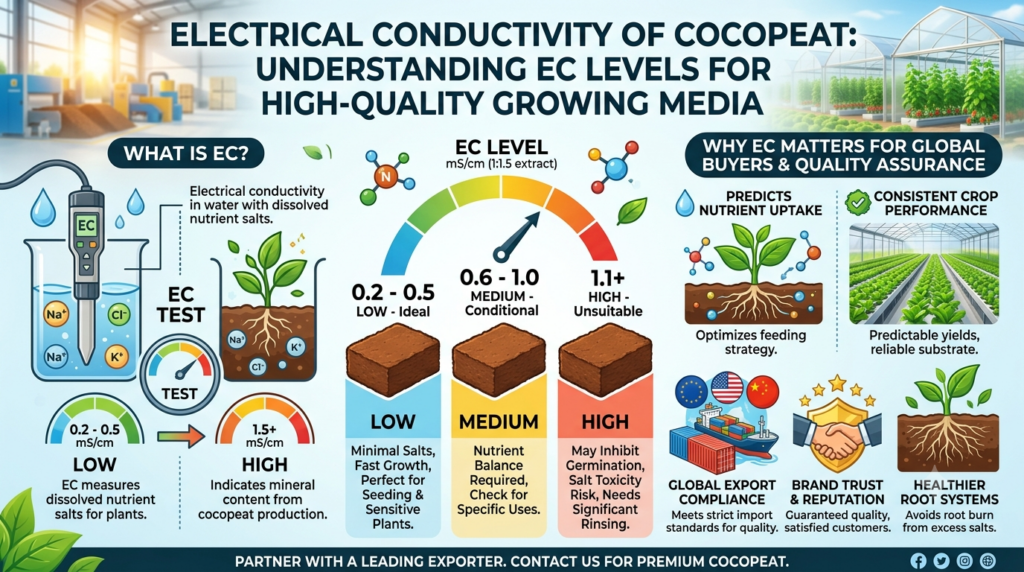
Electrical conductivity (EC) is a measurement used to determine the concentration of dissolved salts in a growing medium.
In cocopeat, EC indicates the amount of soluble minerals and salts remaining after coconut husk processing.
The EC value is commonly measured in:
mS/cm (millisiemens per centimeter)
dS/m (decisiemens per meter)
A higher EC value means there are more dissolved salts present, while a lower EC value indicates fewer soluble salts.
For plants, maintaining the correct EC level is important because excessive salt concentration can interfere with water absorption and nutrient uptake.
Why Electrical Conductivity Matters in Cocopeat
Cocopeat naturally contains minerals from coconut husks. During production, some salts may remain in the material if it is not properly processed.
For commercial agriculture, uncontrolled salt levels can create several challenges.
Impact on Plant Growth
High EC cocopeat may cause:
Reduced seed germination
Slower root development
Leaf damage
Nutrient imbalance
Lower crop productivity
Sensitive crops such as strawberries, lettuce, tomatoes, and ornamental plants require carefully controlled EC levels.
Better Nutrient Management
Low EC cocopeat provides growers with greater control over fertilizer application.
Since the growing medium contains fewer unwanted salts, plants can absorb supplied nutrients more efficiently.
This is especially important in:
Hydroponic farming
Greenhouse vegetable production
Commercial nurseries
Precision agriculture
What Is the Ideal EC Level for Cocopeat?
The ideal EC level depends on crop requirements and cultivation methods.
Generally, export-quality cocopeat is classified into several categories:
Low EC Cocopeat
EC:
Below 0.5 mS/cm
Suitable for:
Hydroponic systems
Seedlings
Sensitive plants
High-value crops
This grade is commonly preferred by professional growers.
Medium EC Cocopeat
EC:
Approximately 0.5 – 1.0 mS/cm
Suitable for:
General gardening
Ornamental plants
Less sensitive crops
High EC Cocopeat
EC:
Above 1.0 mS/cm
May require additional washing before use, especially for commercial cultivation.
How Is EC Reduced During Cocopeat Processing?
Professional cocopeat exporters use several processing methods to achieve the desired EC level.
- Washing Process
Fresh cocopeat is washed with clean water to remove excess soluble salts.
Multiple washing cycles may be required depending on the raw material condition.
This process reduces unwanted minerals and improves product quality.
- Buffering Process
Some premium cocopeat products undergo buffering treatment.
During buffering, calcium solutions are added to replace excess sodium and potassium ions naturally present in coconut husk material.
Benefits include:
Improved nutrient balance
Better root environment
More stable growing performance
Buffered cocopeat is commonly used for commercial greenhouse production.
Reliable cocopeat manufacturers test EC levels before export.
- Quality Testing
Laboratory testing helps confirm that products meet buyer specifications.
Common quality parameters include:
EC level
pH level
Moisture content
Expansion ratio
Fiber percentage
Particle size distribution
Difference Between High EC and Low EC Cocopeat
Understanding the difference helps buyers select the right product.
Low EC Cocopeat
Advantages:
Safer for sensitive crops
Better nutrient control
Suitable for hydroponics
Faster plant adaptation
Preferred by professional growers
Applications:
Greenhouses
Hydroponic farms
Seed propagation
Commercial horticulture
High EC Cocopeat
Characteristics:
Higher salt content
May require additional treatment
Less suitable for sensitive plants
Applications:
Some landscaping projects
Non-sensitive crops
Applications where additional washing is possible
How EC Affects Hydroponic Cocopeat
Hydroponic growers pay close attention to EC because plants depend entirely on controlled nutrient solutions.
In hydroponic systems, the growing medium should provide physical support while allowing growers to manage nutrients precisely.
Low EC cocopeat is preferred because:
Nutrient solutions remain predictable
Salt accumulation risk is reduced
Root systems develop more effectively
Crop quality becomes more consistent
For greenhouse vegetable producers, EC control is a key factor in achieving higher yields.
Why International Buyers Prefer Low EC Cocopeat
Global buyers increasingly request low EC cocopeat because modern agriculture requires precision and consistency.
Importers prefer suppliers that can provide:
Stable EC specifications
Laboratory test reports
Consistent production quality
Proper export packaging
Reliable shipment schedules
Countries with advanced horticultural industries often require strict cocopeat specifications before approving suppliers.
Choosing a Reliable Cocopeat Supplier
When purchasing cocopeat internationally, buyers should evaluate more than price.
Important factors include:
Product Specifications
Ask suppliers about:
EC level
pH range
Moisture content
Expansion ratio
Fiber content
Packaging options
Manufacturing Process
A professional supplier should have clear information about:
Raw material selection
Washing process
Buffering methods
Quality control procedures
Export Experience
Experienced exporters understand international requirements, including:
Shipping documentation
Packaging standards
Customer specifications
Import regulations
A reliable supplier helps buyers maintain consistent product quality for their customers.
Why Indonesia Produces High-Quality Cocopeat
Indonesia has abundant coconut resources, making it one of the important sources of cocopeat for global markets.
Many Indonesian manufacturers produce:
Low EC cocopeat
Washed cocopeat
Buffered cocopeat
Cocopeat blocks
Cocopeat grow bags
With proper processing technology, Indonesian cocopeat can meet the requirements of international agricultural markets.
Conclusion
Understanding the electrical conductivity of cocopeat is essential for growers and international buyers who want reliable and high-performance growing media.
EC level determines the amount of soluble salts in cocopeat and directly influences plant health, nutrient management, and cultivation success.
For professional agriculture, low EC cocopeat is often the preferred choice because it provides a cleaner, more controlled growing environment.
By selecting an experienced cocopeat exporter that provides consistent quality, proper processing, and accurate EC specifications, buyers can build a reliable supply chain for modern horticultural markets worldwide.
As sustainable farming continues to expand, export-quality low EC cocopeat will remain an important solution for greenhouse cultivation, hydroponics, and commercial agriculture.