
Introduction
As growers around the world look for sustainable alternatives to traditional soil, cocopeat has become one of the most trusted growing media in modern horticulture. From commercial greenhouses to home gardens, this natural material supports healthy root development while improving water efficiency and plant performance.
If you are wondering how to use cocopeat for plants, the good news is that it is simple, versatile, and suitable for a wide range of crops. Whether you grow vegetables, flowers, herbs, fruit trees, or ornamental plants, cocopeat can create an ideal environment for stronger roots and healthier growth.
For international importers and agricultural distributors, understanding the correct use of cocopeat also highlights why high-quality export-grade cocopeat continues to experience increasing global demand.
What Is Cocopeat?
Cocopeat is a natural growing medium produced from the fine pith found inside coconut husks. During coconut fiber extraction, this soft material is collected, cleaned, dried, and compressed into blocks, briquettes, or grow bags.
Unlike ordinary garden soil, cocopeat offers a unique balance between moisture retention and air circulation. These characteristics allow plant roots to absorb water efficiently while still receiving the oxygen they need.
Because it is renewable and biodegradable, cocopeat is widely recognized as an environmentally friendly alternative to peat moss.
Why Plants Grow Well in Cocopeat
Healthy roots require three essential conditions:
Sufficient moisture
Good oxygen supply
Stable growing structure
Cocopeat naturally provides all three.
Its sponge-like structure absorbs large amounts of water while maintaining thousands of microscopic air pockets that improve root respiration.
As a result, plants experience less stress during hot weather and recover more quickly after transplanting.
How to Use Cocopeat for Plants
Using cocopeat correctly helps maximize its benefits for different types of plants.
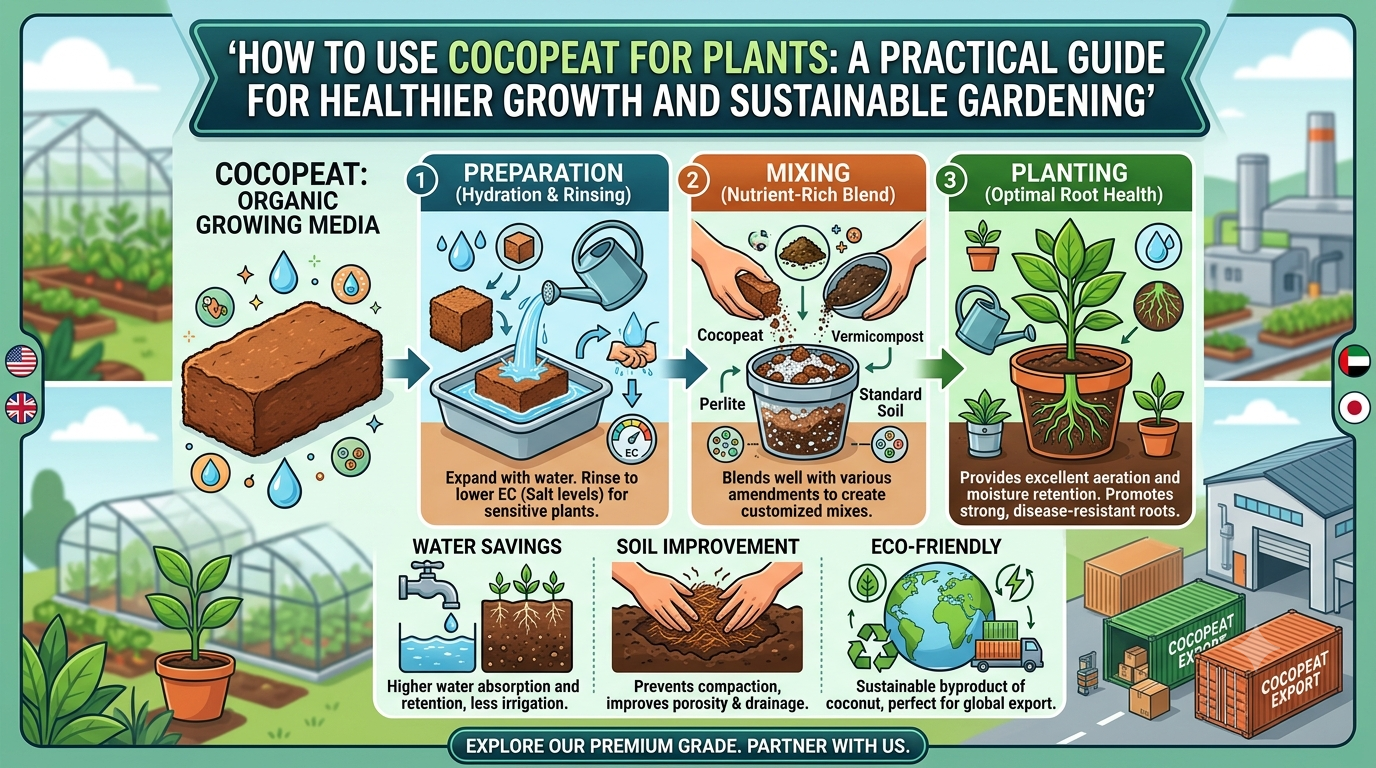
Step 1: Rehydrate the Cocopeat Block
Most export-quality cocopeat is supplied in compressed blocks.
Place the block inside a large container and gradually add clean water.
Allow the block to absorb water for approximately 20 to 30 minutes.
Once fully expanded, loosen the material until it becomes light and fluffy.
Proper hydration ensures even moisture throughout the growing medium.
Step 2: Prepare the Growing Mix
Although cocopeat can be used alone for certain applications, many growers combine it with other growing materials.
Popular mixtures include:
70% cocopeat + 30% perlite
60% cocopeat + 40% compost
50% cocopeat + 50% coco chips
70% cocopeat + 30% rice husk
These combinations improve drainage while maintaining excellent water retention.
The ideal mixture depends on the crop and local climate.
Step 3: Fill Pots or Planting Containers
Fill pots, nursery bags, seed trays, or raised beds with the prepared cocopeat mixture.
Avoid compressing the media too firmly.
Loose cocopeat encourages better root penetration and improves oxygen movement around the root zone.
Step 4: Plant Carefully
Place seedlings or young plants into the prepared media.
Cover the roots gently and water immediately after planting.
The stable moisture conditions reduce transplant shock and encourage faster establishment.
Step 5: Water According to Plant Needs
Although cocopeat stores water efficiently, watering schedules should still match the requirements of each crop.
Always check the moisture level before watering.
The media should remain moist without becoming waterlogged.
Proper irrigation prevents root diseases while maintaining healthy growth.
Step 6: Apply Nutrients Regularly
Unlike compost or fertile garden soil, cocopeat contains very few nutrients.
Plants grown in cocopeat require a balanced fertilizer program.
Growers commonly use:
NPK fertilizers
Organic liquid fertilizers
Compost tea
Hydroponic nutrient solutions
Controlled-release fertilizers
Regular feeding ensures continuous plant development throughout the growing season.
Best Plants for Cocopeat
Cocopeat performs well with many different plant varieties.
Popular choices include:
Vegetables
Tomatoes
Cucumbers
Lettuce
Spinach
Chili peppers
Eggplants
Fruits
Strawberries
Blueberries
Melons
Herbs
Basil
Mint
Parsley
Coriander
Flowers
Roses
Orchids
Marigolds
Gerberas
Indoor Plants
Monstera
Pothos
Peace Lily
Snake Plant
Philodendron
Its versatility makes cocopeat suitable for both commercial agriculture and indoor gardening.
Advantages of Using Cocopeat for Plants
Growers choose cocopeat because it offers numerous practical benefits.
Better Water Efficiency
Cocopeat retains moisture longer than many traditional growing media, reducing irrigation frequency.
Improved Root Development
The porous structure encourages stronger and healthier root systems.
Excellent Drainage
Although it stores water, excess moisture drains effectively, reducing the risk of root rot.
Lightweight Material
Compressed cocopeat is easy to transport and economical for international shipping.
Sustainable Production
Since cocopeat is made from coconut by-products, it supports environmentally responsible agriculture.
Common Mistakes to Avoid
Even high-quality cocopeat should be used correctly.
Avoid these common mistakes:
Using dry cocopeat without proper hydration.
Applying excessive water.
Ignoring fertilizer requirements.
Using unwashed cocopeat with high salt levels.
Compressing the growing media too tightly.
Neglecting pH and EC monitoring in commercial production.
Following proper growing practices ensures better plant performance.
Choosing Export-Quality Cocopeat
For commercial growers and international buyers, product consistency is essential.
Reliable manufacturers produce cocopeat with specifications such as:
Low EC
Stable pH
High water holding capacity
Uniform particle size
Excellent expansion ratio
Low moisture content
Minimal dust
Free from contaminants
Secure export packaging
These quality indicators help growers achieve consistent cultivation results.
Why International Buyers Choose Cocopeat
Global demand for cocopeat continues to increase as agriculture moves toward sustainable production systems.
Compared with peat moss, cocopeat offers several advantages:
Renewable raw material
Lower environmental impact
Reliable availability
Excellent physical properties
Efficient shipping through compressed packaging
For distributors, wholesalers, and agricultural suppliers, premium cocopeat represents a valuable product for modern horticultural markets.
Conclusion
Understanding how to use cocopeat for plants allows growers to maximize plant health while improving water management and root development.
From seed germination to greenhouse production, cocopeat provides a clean, renewable, and highly effective growing medium suitable for numerous crops.
For international importers seeking dependable supply, selecting export-quality cocopeat from an experienced manufacturer ensures consistent product performance, easier logistics, and long-term customer satisfaction.
As sustainable agriculture continues to expand worldwide, cocopeat remains one of the smartest growing media choices for professional growers and home gardeners alike.