
Cocopeat Hydroponics: A Sustainable Growing Medium for Modern Farming
Hydroponic farming continues to grow rapidly as farmers search for efficient and sustainable ways to produce crops. Unlike traditional agriculture, hydroponics allows growers to control water, nutrients, and growing conditions more effectively.
Among various hydroponic growing media, cocopeat has become one of the most popular choices worldwide. Made from coconut husks, cocopeat provides excellent moisture control, strong root support, and a natural environment for plant development.
For greenhouse owners, commercial farmers, and agricultural companies, choosing high-quality cocopeat hydroponics products can improve crop performance while supporting sustainable farming practices.
What Is Cocopeat for Hydroponics?
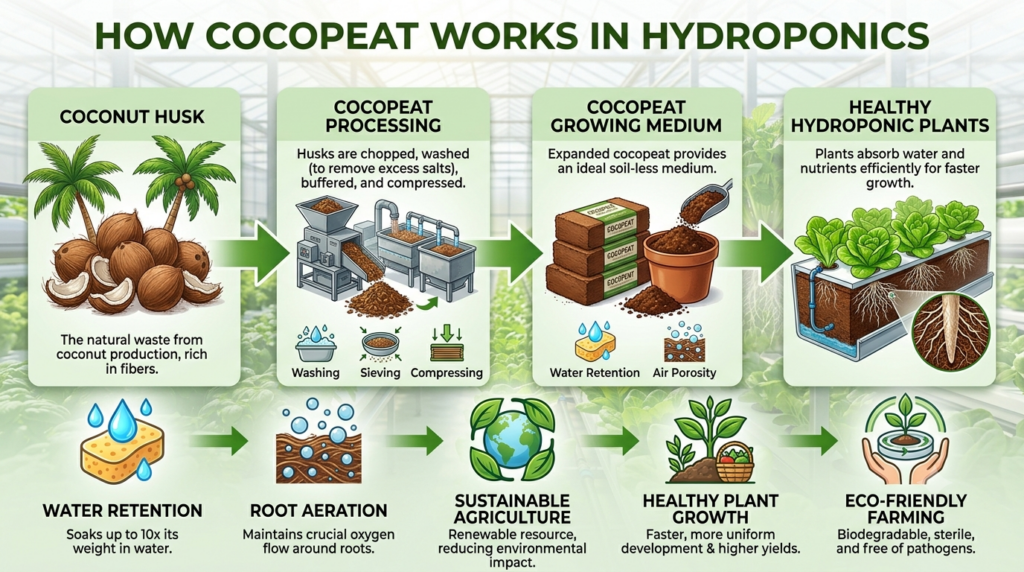
Cocopeat is a natural growing medium created from processed coconut husks. Manufacturers remove the long coconut fibers and collect the fine coconut particles to produce cocopeat.
After processing, suppliers clean, dry, and compress cocopeat into different forms, including blocks, bricks, and loose material.
In hydroponic farming, cocopeat replaces traditional soil and provides a stable environment for plant roots. Instead of depending on soil nutrients, plants receive essential nutrients through water-based fertilizer solutions.
Therefore, cocopeat works as a perfect foundation for modern soilless agriculture.
Why Do Growers Choose Cocopeat Hydroponics?
- Cocopeat Provides Excellent Water Retention
One of the main reasons growers choose cocopeat is its ability to store moisture efficiently.
Cocopeat absorbs water and releases it gradually according to plant needs. At the same time, its porous structure allows excess water to drain properly.
As a result, plants receive consistent hydration without creating overly wet conditions around the roots.
This advantage helps farmers achieve:
Better irrigation efficiency
Reduced water consumption
More stable plant growth
Improved crop quality
Furthermore, cocopeat works especially well in areas where water management plays an important role in agricultural production.
- Cocopeat Improves Root Aeration
Healthy roots need both water and oxygen. However, many traditional growing materials become compact over time and reduce airflow.
Cocopeat solves this problem because its natural structure creates small air spaces around plant roots.
Because of this, roots can breathe more easily and develop stronger systems.
Better root aeration allows plants to:
Absorb nutrients more effectively
Grow faster
Develop stronger structures
Produce healthier harvests
Moreover, strong root development helps plants handle environmental changes more successfully.
- Cocopeat Supports Sustainable Agriculture
Today, many agricultural businesses focus on environmentally friendly solutions. Cocopeat supports this goal because it comes from coconut husks, a renewable agricultural resource.
Instead of allowing coconut waste to become unused material, manufacturers transform it into valuable growing media.
As a result, cocopeat provides a sustainable alternative to traditional growing materials.
For international buyers, this makes cocopeat an attractive choice for eco-conscious farming operations.
How Do Farmers Use Cocopeat in Hydroponic Systems?
Growers use cocopeat in several hydroponic applications depending on their production goals.
Cocopeat in Drip Irrigation Systems
Commercial greenhouse farms commonly use cocopeat slabs or grow bags with drip irrigation systems.
Farmers deliver nutrient solutions directly into the cocopeat, allowing plants to receive controlled amounts of water and fertilizer.
This method works well for crops such as:
Tomatoes
Strawberries
Cucumbers
Peppers
Melons
Furthermore, drip irrigation combined with cocopeat helps farmers improve resource efficiency.
Cocopeat for Container Hydroponics
Small farms, nurseries, and home growers often use cocopeat in containers and grow bags.
The material provides excellent support for plant roots while allowing growers to control nutrients easily.
Therefore, container hydroponics with cocopeat offers a practical solution for different farming scales.
Cocopeat for Seed Germination
Many nurseries use cocopeat as a seed-starting medium.
Because cocopeat creates a clean and soft environment, young roots can grow without difficulty.
In addition, its moisture retention helps maintain suitable conditions during early plant development.
Does Cocopeat Contain Enough Nutrients?
Although cocopeat offers many benefits, it does not provide complete nutrition for plants.
Cocopeat mainly supports plants by providing:
Root stability
Moisture control
Air circulation
A healthy growing environment
However, growers still need to provide additional nutrients through hydroponic fertilizer solutions.
Important nutrients include:
Nitrogen for leaf growth
Phosphorus for root development
Potassium for plant strength
Calcium and magnesium for nutrient balance
For this reason, professional growers often combine premium cocopeat with a complete nutrient program.
What Makes Premium Hydroponic Cocopeat Different?
Not all cocopeat products provide the same quality. Therefore, buyers should carefully evaluate product standards before purchasing.
Low EC Level
Electrical conductivity (EC) measures salt levels in cocopeat.
Premium hydroponic cocopeat should have controlled EC levels because excessive salts can affect plant growth.
Proper Washing Process
Reliable suppliers wash cocopeat carefully to remove unwanted salts and impurities.
As a result, growers can use the product safely for sensitive crops.
Buffered Cocopeat Quality
Buffered cocopeat receives special treatment to improve nutrient balance.
This process helps reduce calcium and magnesium issues, creating better conditions for plant growth.
Consistent Texture
High-quality cocopeat should contain a balanced structure between fine particles and fiber.
This balance provides:
Excellent moisture retention
Proper drainage
Better root development
Why Should International Buyers Choose Cocopeat Hydroponics?
Global agricultural businesses continue to choose cocopeat because it offers practical advantages.
Firstly, cocopeat improves farming efficiency by creating a controlled root environment.
Secondly, compressed cocopeat blocks reduce shipping space, making international transportation easier.
Moreover, cocopeat supports sustainable agriculture by utilizing renewable coconut resources.
Because of these advantages, many greenhouse operators, nurseries, and hydroponic farms worldwide use cocopeat as their preferred growing medium.
How to Choose a Reliable Cocopeat Supplier
Choosing the right supplier plays an important role in achieving successful hydroponic production.
Before placing an order, buyers should consider:
Product quality standards
Washing and buffering processes
Export packaging quality
Consistent supply capacity
International shipping experience
A professional cocopeat supplier helps businesses receive reliable products that meet agricultural requirements.
Therefore, working with an experienced exporter can support long-term farming success.
Conclusion: Cocopeat Hydroponics for the Future of Agriculture
Cocopeat hydroponics provides a sustainable and efficient solution for modern farming.
With excellent water retention, strong root support, and environmentally friendly characteristics, cocopeat helps growers produce healthier plants with better resource management.
Furthermore, premium cocopeat offers international buyers a reliable growing medium for greenhouses, nurseries, and commercial hydroponic systems.
For farmers and agricultural businesses searching for a high-performance growing solution, cocopeat is more than just a planting material—it is a sustainable investment for the future of agriculture.