
Introduction
One of the most common questions asked by growers, importers, and agricultural professionals is: Does cocopeat absorb water?
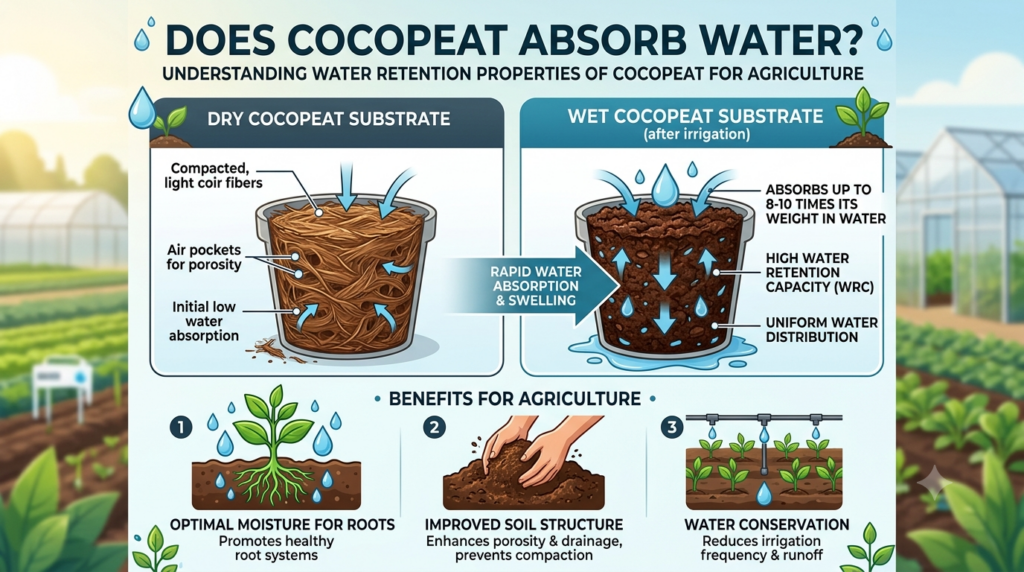
The answer is yes. Cocopeat has excellent water absorption and water retention capabilities, making it one of the most popular sustainable growing media used in modern agriculture.
For commercial growers, greenhouse operators, hydroponic farmers, and international buyers, understanding the water absorption properties of cocopeat is essential before selecting the right growing medium. The ability of cocopeat to store moisture while maintaining proper air circulation makes it highly valuable for plant cultivation in different climates.
As global demand for sustainable horticultural products continues to increase, export-quality cocopeat has become a preferred alternative to traditional growing media such as peat moss.
What Is Cocopeat?
Cocopeat is a natural growing medium made from the fine particles inside coconut husks. During coconut fiber processing, the soft material between coconut fibers is collected, cleaned, dried, and compressed into blocks, briquettes, or grow bags.
Unlike ordinary soil, cocopeat has a unique porous structure containing millions of tiny spaces that can hold water and air simultaneously.
This natural structure allows cocopeat to provide two important conditions for plant growth:
Adequate moisture supply
Sufficient oxygen for healthy roots
These characteristics make cocopeat suitable for vegetables, fruits, flowers, seedlings, and hydroponic cultivation.
Does Cocopeat Absorb Water?
Yes, cocopeat absorbs water extremely well.
The cellular structure of coconut coir contains tiny capillary spaces that allow cocopeat particles to attract and store water. When dry cocopeat comes into contact with water, it expands significantly and becomes soft, moist, and lightweight.
Compressed cocopeat blocks can expand several times their original size after hydration.
This water absorption ability provides several advantages:
Reduces watering frequency
Maintains consistent moisture around roots
Helps plants survive in hot climates
Improves nutrient distribution
Supports healthier plant development
For international buyers, high water absorption capacity is one of the important quality indicators when evaluating cocopeat products.
How Much Water Can Cocopeat Hold?
The water holding capacity of cocopeat depends on several factors, including:
Fiber content
Particle size
Processing method
Quality grade
Compression level
High-quality cocopeat can retain several times its own weight in water while still maintaining good drainage.
This balance is what makes cocopeat different from many other growing media.
A material that holds too much water may cause root problems, while a material that drains too quickly may require frequent irrigation.
Cocopeat provides a middle ground by storing moisture while allowing excess water to escape.
Why Water Absorption Is Important for Plants
Plants need a consistent supply of water to transport nutrients and support photosynthesis.
However, roots also require oxygen.
Poor growing media can create problems such as:
Waterlogging
Root suffocation
Nutrient imbalance
Slow plant growth
Cocopeat solves this problem through its natural structure.
The material absorbs enough water for plant needs while maintaining air pockets around the root zone.
This creates an ideal environment for stronger roots and healthier plants.
Benefits of Cocopeat’s Water Retention Ability
- Reduces Irrigation Frequency
Because cocopeat stores moisture effectively, growers do not need to water plants as frequently compared with many traditional growing media.
This is especially beneficial in:
Dry climates
Greenhouse farming
Commercial nurseries
Water-saving agriculture systems
- Improves Root Development
Healthy roots require both water and oxygen.
Cocopeat maintains moisture while preventing excessive compaction, allowing roots to spread naturally.
Stronger roots help plants absorb nutrients more efficiently.
- Supports Hydroponic Farming
Hydroponic growers often choose cocopeat because it provides physical support for roots while allowing precise nutrient management.
Its water absorption characteristics make it suitable for:
Hydroponic tomatoes
Cucumbers
Strawberries
Lettuce
Peppers
- Helps Maintain Stable Growing Conditions
Environmental changes such as heat and low humidity can quickly affect plants.
Cocopeat helps reduce moisture fluctuations by slowly releasing stored water to plant roots.
This stability improves plant performance throughout the growing cycle.
How to Prepare Cocopeat for Maximum Water Absorption
Proper preparation is important to achieve the best results.
Step 1: Expand the Cocopeat
Compressed cocopeat blocks should be placed in a container and hydrated with clean water.
Allow enough time for the block to fully expand.
Step 2: Fluff the Material
After expansion, loosen the cocopeat manually or mechanically.
This improves air circulation and prevents compact areas.
Step 3: Check Moisture Balance
The ideal cocopeat condition is moist but not saturated.
When squeezed gently, it should feel damp without releasing excessive water.
Step 4: Mix With Other Materials if Needed
Depending on the crop, cocopeat may be combined with:
Perlite
Vermiculite
Vermicompost
Compost
Coco chips
These combinations can improve drainage, nutrients, or aeration.
Factors That Affect Cocopeat Water Absorption
Not all cocopeat products have identical performance.
Several factors influence water absorption:
Particle Size
Fine cocopeat particles generally hold more water, while larger particles provide better drainage.
Fiber Content
A balanced fiber ratio improves air circulation and water distribution.
Processing Quality
Properly processed cocopeat provides more consistent moisture retention.
Export-grade cocopeat usually undergoes screening, washing, and quality testing.
EC Level
Electrical conductivity (EC) affects the suitability of cocopeat for different crops.
Low EC cocopeat is commonly preferred for sensitive plants because it provides better control over nutrient management.
Why International Buyers Prefer Water-Absorbing Cocopeat
For global agricultural markets, efficient water management has become increasingly important.
International buyers choose premium cocopeat because it offers:
High water holding capacity
Renewable raw materials
Reduced irrigation requirements
Better root environment
Easy transportation through compression
Compatibility with modern farming systems
Countries with greenhouse industries and water limitations especially value cocopeat as an efficient growing medium.
Choosing Export Quality Cocopeat
When purchasing cocopeat internationally, buyers should consider several specifications:
Water holding capacity
Expansion ratio
EC level
pH range
Moisture content
Fiber percentage
Particle size consistency
Packaging quality
A reliable cocopeat exporter should provide clear product specifications and quality assurance.
Cocopeat vs Traditional Soil for Water Retention
Traditional soil can vary greatly depending on location and composition.
Some soils drain too quickly, while others hold excessive water.
Cocopeat offers a more controlled growing environment because its structure is processed and standardized.
Advantages compared with ordinary soil include:
More consistent moisture control
Better root aeration
Cleaner growing environment
Easier transportation
Suitable for container farming
Conclusion
So, does cocopeat absorb water? Yes, cocopeat has excellent water absorption and retention properties, making it one of the most effective growing media for modern agriculture.
Its unique ability to hold moisture while maintaining oxygen around plant roots makes it suitable for hydroponics, greenhouse farming, nurseries, and commercial cultivation.
For international buyers, choosing export-quality cocopeat with excellent water retention characteristics ensures better crop performance and long-term reliability.
As sustainable agriculture continues to grow worldwide, cocopeat remains an important solution for growers seeking efficient water management and environmentally friendly growing media.