Introduction
The global demand for sustainable growing media has increased rapidly over the past decade. As commercial growers, greenhouse operators, hydroponic farms, and horticultural distributors search for environmentally responsible alternatives to peat moss, cocopeat has become one of the most preferred solutions.
However, one question continues to appear among international buyers:
What is cocopeat made of?
The answer is simple, yet understanding the manufacturing process helps buyers evaluate product quality before placing bulk export orders.
Cocopeat is made from the soft, sponge-like material found between the coarse fibers of a coconut husk. Instead of being discarded as agricultural waste, this natural material is carefully processed into a high-performance growing medium used worldwide.
Whether you are an importer, distributor, nursery owner, or commercial farm manager, knowing how cocopeat is produced will help you choose the right supplier and ensure consistent product quality.
What Is Cocopeat Made Of?
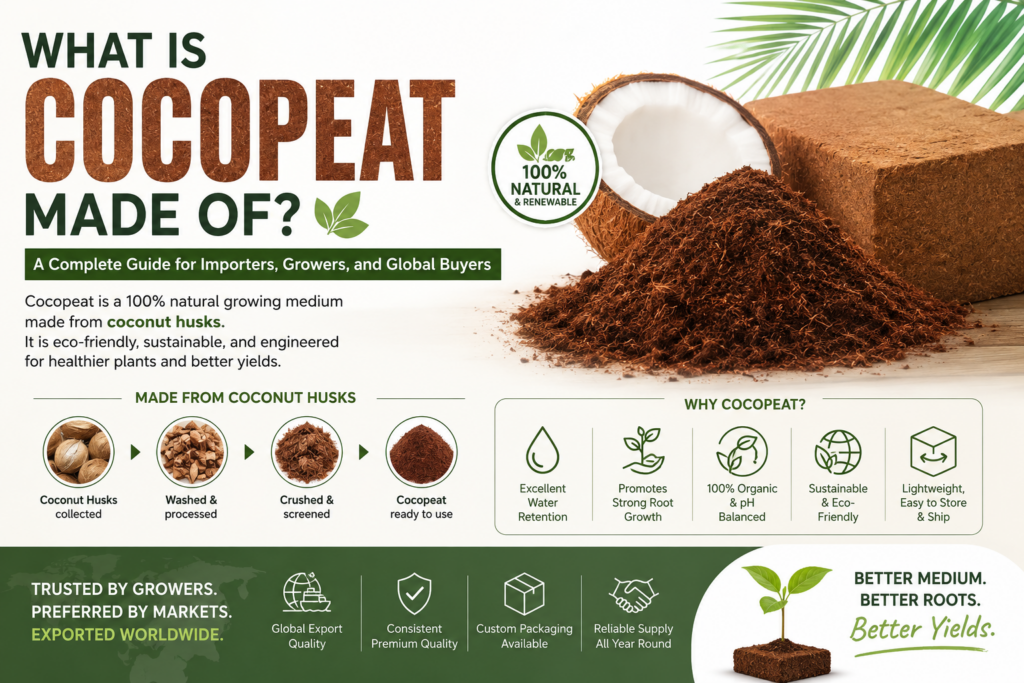
Cocopeat is made from coconut husks, the thick outer covering that protects the coconut fruit.
A coconut has several layers:
Outer skin (exocarp)
Thick fibrous husk (mesocarp)
Hard shell
Coconut meat
Coconut water
The husk contains two valuable materials:
Long coconut fibers (coir fiber)
Fine pith particles (cocopeat)
During fiber extraction, manufacturers separate the long fibers used in ropes, mats, brushes, mattresses, and erosion control products. The remaining fine particles are collected and processed into cocopeat.
Rather than being a synthetic product, cocopeat is entirely derived from a renewable agricultural resource, making it one of the most sustainable growing media available today.
How Cocopeat Is Produced
The manufacturing process plays an important role in determining product quality.
- Coconut Husk Collection
Fresh or mature coconut husks are collected from coconut processing facilities.
Countries with large coconut industries, including Indonesia, India, Sri Lanka, and Vietnam, produce significant quantities of raw coconut husks every year.
- Fiber Extraction
Mechanical decortication machines separate the long coconut fibers from the soft pith.
At this stage, the fine material that becomes cocopeat is collected for further processing.
- Drying
The pith is dried naturally under sunlight or using controlled drying systems until the moisture content reaches export standards.
Proper drying reduces the risk of mold growth during international shipping.
- Screening
The dried cocopeat is screened to remove oversized fibers, stones, dust, and impurities.
Depending on customer requirements, manufacturers can produce different particle sizes.
- Washing and Buffering
Premium export-quality cocopeat is often washed several times to reduce soluble salts.
Some grades are also buffered with calcium solutions to replace excess sodium and potassium.
This process produces low EC cocopeat suitable for sensitive crops.
- Compression
After quality inspection, cocopeat is compressed into various packaging formats such as:
5 kg blocks
Briquettes
Grow bags
Open-top bags
Loose bags
Jumbo bags
Compression reduces shipping costs while allowing the product to expand several times after adding water.
Natural Components of Cocopeat
Many buyers wonder whether cocopeat contains chemicals or artificial ingredients.
The answer is no.
High-quality cocopeat consists mainly of natural organic components, including:
Lignin
Cellulose
Organic carbon
Natural air pores
Moisture-retaining particles
Because of its natural composition, cocopeat decomposes much more slowly than many organic growing media.
This allows growers to use it over multiple cultivation cycles with proper management.
Why Cocopeat Is an Excellent Growing Medium
The physical structure of cocopeat provides several important benefits.
Excellent Water Retention
Tiny pores absorb and store large amounts of water while still allowing excess moisture to drain.
Superior Aeration
Healthy roots require oxygen.
The porous structure of cocopeat creates numerous air pockets that improve root respiration.
Stable Structure
Unlike ordinary soil, cocopeat maintains its texture over time and resists compaction.
Lightweight
Compressed cocopeat significantly reduces transportation and storage costs for international buyers.
Eco-Friendly
Since cocopeat is produced from coconut by-products, it supports waste reduction and sustainable agriculture.
Is Cocopeat Organic?
Yes.
Cocopeat is a natural organic growing medium because it originates from coconut husks.
However, buyers seeking certified organic production should verify whether the manufacturer holds internationally recognized organic certifications.
Certification requirements vary depending on the destination market.
Is Cocopeat the Same as Coconut Fiber?
No.
Although both products come from coconut husks, they serve different purposes.
Coconut fiber consists of long, coarse strands used in industrial products such as ropes, brushes, geotextiles, and erosion control blankets.
Cocopeat consists of the fine particles remaining after fiber extraction and is primarily used as a growing medium for horticulture and agriculture.
Many export customers purchase both products together depending on their application.
Industries That Use Cocopeat
Cocopeat has become an essential material in many industries worldwide.
Common applications include:
Commercial greenhouses
Hydroponic farming
Vegetable production
Fruit cultivation
Flower nurseries
Tree seedling production
Landscaping
Organic farming
Home gardening
Indoor plant cultivation
Its versatility has contributed to the steady growth of the international cocopeat market.
What International Buyers Look For
Professional importers evaluate several quality indicators before purchasing cocopeat.
These include:
Low electrical conductivity (EC)
Balanced pH
High water holding capacity
Excellent expansion ratio
Low moisture content
Minimal dust
Uniform particle size
Clean appearance
Free from contaminants
Reliable export packaging
Manufacturers capable of meeting these specifications are generally preferred by distributors and agricultural companies.
Why Indonesia Is a Leading Source of Cocopeat
Indonesia is one of the world’s largest coconut-producing countries.
Its abundant coconut resources provide a stable supply of raw materials for cocopeat production.
Many Indonesian manufacturers produce washed, buffered, and compressed cocopeat suitable for export to Europe, North America, Australia, the Middle East, and Asia.
International buyers often value Indonesian cocopeat because of its consistent quality, competitive pricing, and reliable production capacity.
Conclusion
Understanding what cocopeat is made of helps buyers make informed sourcing decisions.
Cocopeat is produced from the soft pith found inside coconut husks after the long fibers have been removed. Through washing, drying, screening, and compression, this natural material becomes a premium growing medium used by growers around the world.
Its excellent moisture retention, superior aeration, renewable origin, and versatility make cocopeat one of the most sustainable choices for modern horticulture.
For importers and distributors seeking long-term supply, partnering with an experienced exporter that offers consistent quality, proper quality control, and international shipping support is essential for building a reliable business relationship.