
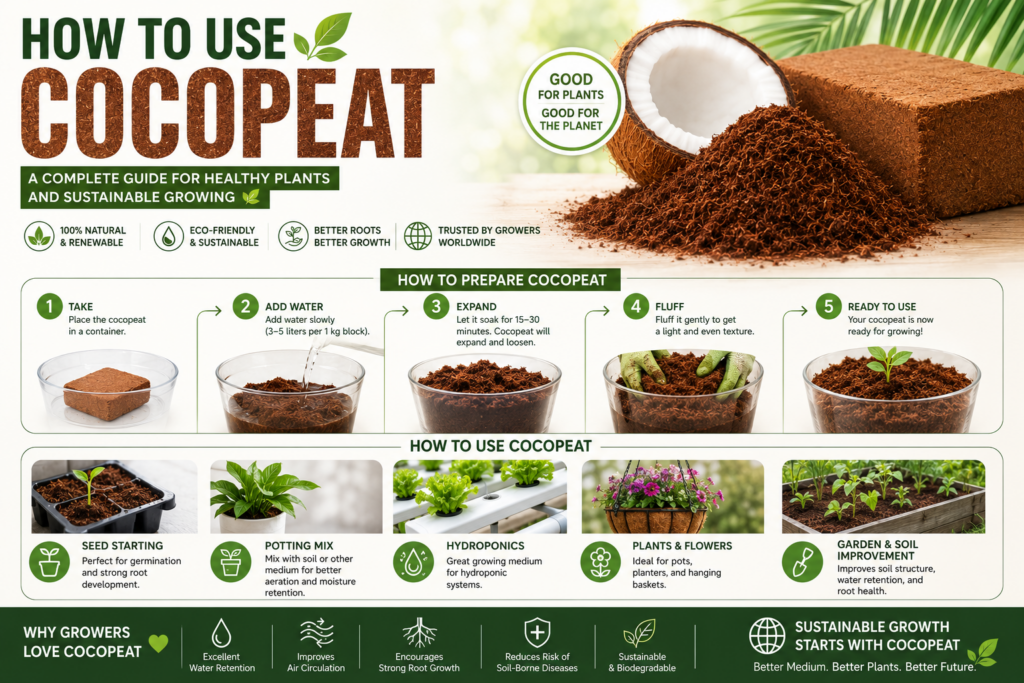
As modern agriculture continues to shift toward sustainable growing methods, cocopeat has become one of the most trusted growing media for commercial farms, home gardeners, nurseries, and hydroponic systems. Made from coconut husk fibers, cocopeat is an environmentally friendly alternative to peat moss because it is renewable, biodegradable, and highly efficient at retaining water.
Whether you are growing vegetables, flowers, herbs, fruits, or ornamental plants, learning how to use cocopeat correctly can significantly improve root development, water efficiency, and overall crop performance.
If you are searching for premium cocopeat for agriculture or looking for a reliable supplier for international export, understanding the proper application of cocopeat is the first step toward achieving healthier plants and higher yields.
What Is Cocopeat?
Cocopeat, also called coco pith or coir pith, is a natural by-product of coconut processing. During the extraction of coconut fiber, the remaining soft material is collected, washed, buffered if necessary, dried, and compressed into blocks, briquettes, or grow bags.
Unlike ordinary garden soil, cocopeat provides a clean and consistent growing environment. It contains millions of tiny pores that hold both water and oxygen, creating ideal conditions for healthy root systems.
Today, cocopeat is widely exported to countries across Europe, North America, Australia, the Middle East, Japan, and South Korea for commercial horticulture and greenhouse farming.
Why Choose Cocopeat?
Many professional growers prefer cocopeat because it offers several important advantages.
Some of its main benefits include:
Excellent water retention
High air porosity
Lightweight and easy to transport
Renewable and eco-friendly
Free from weeds when properly processed
Suitable for organic farming
Improves root development
Reduces irrigation frequency
Easy to mix with other growing media
These characteristics make cocopeat suitable for both small-scale gardening and large agricultural operations.
How to Use Cocopeat Step by Step
Using cocopeat correctly helps maximize its performance. Follow these simple steps.
- Rehydrate the Cocopeat Block
Most exported cocopeat comes in compressed blocks.
Place the block inside a large container and slowly add clean water.
Within 15–30 minutes, the compressed block expands several times its original size.
Fluff the material by hand until it becomes loose and evenly moist.
Avoid using excessive water because overly wet cocopeat may reduce air circulation around plant roots.
- Check Moisture Level
The ideal cocopeat should feel moist but not dripping wet.
When squeezed gently, only a few drops of water should come out.
Maintaining this moisture level encourages healthy root growth while preventing waterlogging.
- Use Cocopeat Alone or Mix with Other Media
Cocopeat can be used by itself or blended with other growing materials depending on the crop.
Common mixing ratios include:
70% cocopeat + 30% perlite
60% cocopeat + 40% compost
50% cocopeat + 50% coco chips
70% cocopeat + 30% rice husk
Each mixture provides different drainage and aeration characteristics.
Commercial greenhouse growers often combine cocopeat with perlite to achieve consistent moisture management.
- Plant Seeds or Seedlings
Fill seed trays, nursery pots, or planting containers with prepared cocopeat.
Plant seeds according to the recommended depth for each crop.
Because cocopeat has a fine texture, young roots can easily penetrate the growing medium.
Seed germination is often faster thanks to the stable moisture conditions.
- Apply Nutrients
Unlike compost, cocopeat contains very limited plant nutrients.
For this reason, regular fertilization is essential.
Growers commonly apply:
Balanced NPK fertilizer
Organic liquid fertilizer
Compost tea
Hydroponic nutrient solutions
A proper nutrient program ensures vigorous growth throughout the cultivation cycle.
How Often Should You Water Cocopeat?
One of the biggest advantages of cocopeat is its ability to retain moisture.
Although watering frequency depends on climate and crop type, plants grown in cocopeat generally require less frequent irrigation than those grown in ordinary soil.
Always check moisture before watering.
Avoid keeping cocopeat permanently saturated because roots also require oxygen.
Best Plants for Cocopeat
Cocopeat is extremely versatile and supports many different crops.
Popular applications include:
Tomatoes
Cucumbers
Chili peppers
Strawberries
Lettuce
Spinach
Basil
Roses
Orchids
Succulents
Indoor houseplants
Tree seedlings
Its excellent balance of moisture retention and aeration makes it suitable for both food crops and ornamental plants.
Cocopeat for Hydroponics
Hydroponic growers frequently choose cocopeat because it creates a stable root environment.
Compared with traditional soil, cocopeat provides:
Better oxygen availability
Uniform moisture distribution
Cleaner production
Reduced soil-borne diseases
Easy root inspection
Many greenhouse vegetable producers rely on buffered cocopeat slabs or grow bags for year-round production.
Tips for Using Cocopeat Successfully
To obtain the best results, consider the following recommendations.
Choose washed and low EC cocopeat for sensitive crops.
Store unused cocopeat in a dry location.
Avoid compacting the growing medium.
Monitor irrigation regularly.
Supply balanced fertilizers throughout the growing season.
Replace old cocopeat after several production cycles if it begins to lose structure.
Good quality cocopeat can often be reused after proper cleaning and sterilization.
Common Mistakes When Using Cocopeat
Even experienced growers occasionally make mistakes.
Some of the most common include:
Using cocopeat without adding nutrients.
Overwatering the growing medium.
Choosing unwashed cocopeat with excessive salt levels.
Compressing the media too tightly inside containers.
Ignoring pH and EC management for commercial production.
Avoiding these mistakes helps maximize crop performance.
Choosing High-Quality Cocopeat for Export
Not all cocopeat products are manufactured to the same standard.
Professional buyers usually evaluate several important specifications before placing export orders.
Key factors include:
Low EC level
Correct pH range
High water holding capacity
Minimal dust content
Proper fiber ratio
Low moisture during shipping
Consistent expansion ratio
Free from contaminants
Export-grade packaging
Reliable phytosanitary compliance
Working with an experienced manufacturer ensures consistent quality for international markets.
Why International Buyers Prefer Cocopeat
Demand for cocopeat continues to grow because commercial agriculture increasingly focuses on sustainability.
Compared with non-renewable peat moss, cocopeat offers a renewable alternative with excellent physical properties.
Export buyers value cocopeat because it helps reduce transportation costs through compressed packaging while expanding significantly after hydration.
It also supports environmentally responsible farming practices that align with modern agricultural standards.
Conclusion
Understanding how to use cocopeat correctly allows growers to improve water efficiency, encourage stronger root systems, and produce healthier plants throughout the growing season.
Whether you are managing a commercial greenhouse, hydroponic farm, tree nursery, or home garden, high-quality cocopeat provides a reliable growing medium suitable for a wide range of crops.
For importers, distributors, wholesalers, and agricultural companies seeking consistent quality, choosing export-grade cocopeat from an experienced manufacturer ensures better performance and long-term customer satisfaction.
As global demand for sustainable horticultural products continues to increase, cocopeat remains one of the most practical and environmentally responsible growing media available today.
Primary Keyword
how to use cocopeat
Secondary Keywords
cocopeat growing medium
cocopeat for plants
how to prepare cocopeat
cocopeat for gardening
cocopeat for seed starting
cocopeat for hydroponics
cocopeat soil alternative
coconut coir growing medium
cocopeat supplier
export quality cocopeat
Long-Tail Keywords
how to use cocopeat for vegetable gardening
how to prepare cocopeat block before planting
best way to use cocopeat for seedlings
how to mix cocopeat with soil
how to use cocopeat for indoor plants
cocopeat for greenhouse farming
premium cocopeat supplier for export
bulk cocopeat exporter Indonesia
low EC washed cocopeat manufacturer
sustainable coconut coir growing medium supplier